
How AI Is Transforming Small Businesses: Practical Use Cases and Benefits in 2026
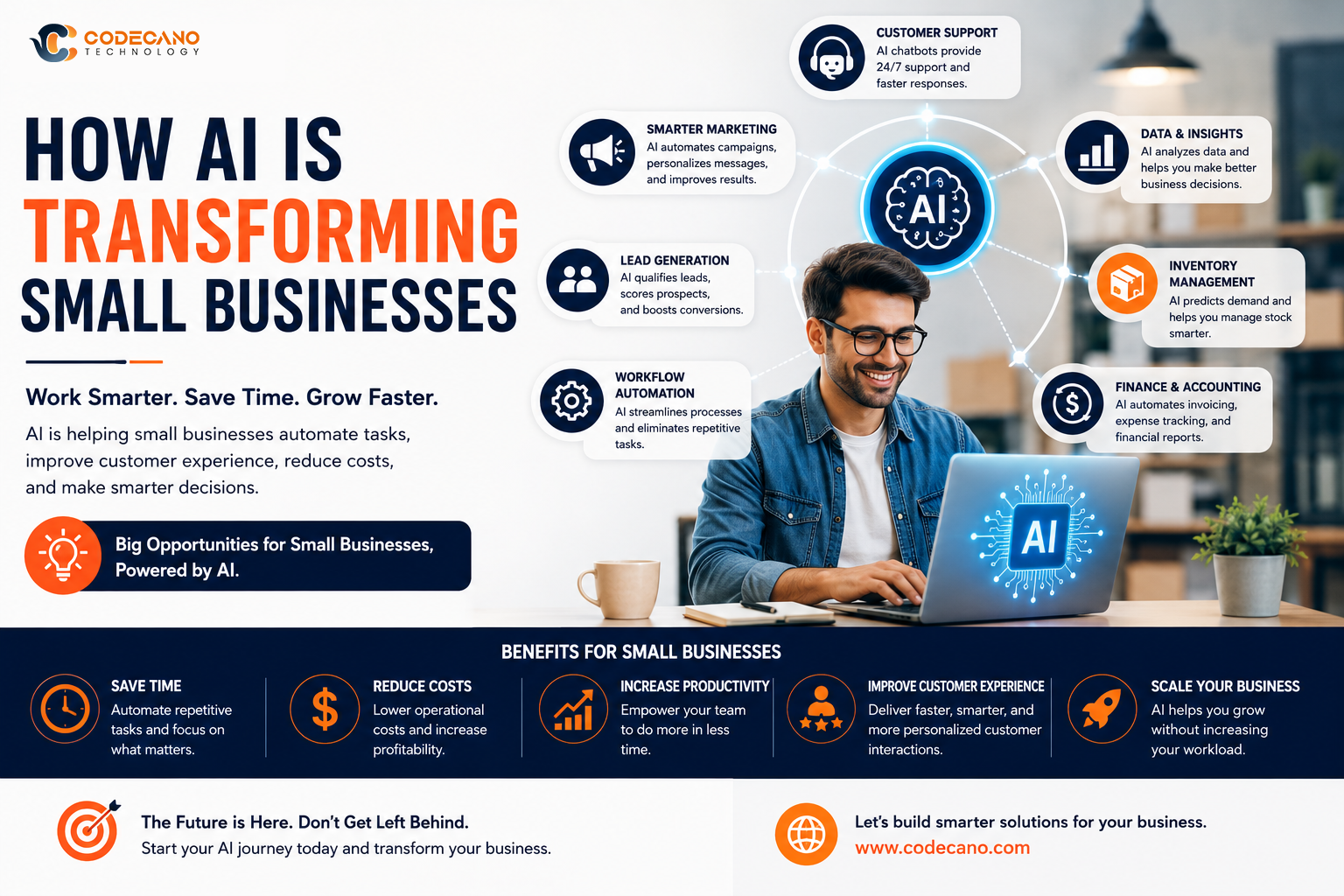
Artificial Intelligence is no longer just for large enterprises. Small businesses are using AI to automate repetitive tasks, improve customer service, reduce costs, and grow faster. Discover how AI is transforming small businesses and how you can start leveraging it today.
How AI Is Transforming Small Businesses
For years, Artificial Intelligence (AI) was considered a technology only large corporations could afford.
Today, that's no longer the case.
Affordable AI tools, cloud platforms, and custom AI solutions have made it possible for small businesses to compete with much larger organizations.
Whether you're running a retail store, an eCommerce business, a service company, or a growing startup, AI can help you work smarter—not harder.
In this guide, we'll explore how AI is transforming small businesses, practical use cases, and why now is the right time to adopt AI.
Why Small Businesses Are Adopting AI
Small businesses often face common challenges:
- Limited staff
- Time-consuming manual work
- Rising operational costs
- Growing customer expectations
- Increasing competition
AI helps solve these challenges by automating repetitive tasks, improving decision-making, and allowing teams to focus on higher-value work.
Instead of hiring additional employees for every new process, businesses can automate many routine operations while maintaining quality and efficiency.
1. AI-Powered Customer Support
Customers expect quick responses—regardless of the time of day.
AI-powered chatbots can:
- Answer frequently asked questions
- Track orders
- Schedule appointments
- Recommend products
- Collect customer information
- Provide instant support 24/7
Benefits:
- Faster response times
- Reduced support costs
- Improved customer satisfaction
- Higher conversion rates
2. Smarter Lead Generation
Not every website visitor is ready to buy.
AI can automatically:
- Capture leads
- Qualify prospects
- Score potential customers
- Schedule sales calls
- Route leads to the right sales representative
Your sales team spends less time filtering leads and more time closing deals.
3. Sales and Marketing Automation
Marketing involves repetitive tasks that consume valuable time.
AI can assist with:
- Email marketing
- Personalized campaigns
- Social media scheduling
- Content ideas
- Customer segmentation
- Performance analysis
This allows small businesses to maintain a consistent marketing presence without significantly increasing workload.
4. Document Processing
Many businesses still manually process:
- Invoices
- Receipts
- Contracts
- Purchase orders
- PDFs
- Forms
AI can extract data, organize documents, and reduce manual entry, improving accuracy and saving hours each week.
5. Business Workflow Automation
Routine processes often slow down business growth.
AI can automate workflows such as:
- Employee onboarding
- Internal approvals
- CRM updates
- Customer follow-ups
- Task assignments
- Project notifications
Automation helps teams work more efficiently while reducing delays and human error.
6. Better Business Decisions with AI
Every business generates valuable data.
AI helps transform that data into actionable insights by:
- Identifying trends
- Predicting demand
- Monitoring performance
- Detecting unusual patterns
- Creating reports automatically
Business owners can make faster, more informed decisions based on real-time information.
7. Personalized Customer Experiences
Modern customers expect businesses to understand their preferences.
AI can:
- Recommend relevant products
- Personalize website content
- Suggest services
- Send targeted offers
- Improve customer engagement
Personalization increases customer satisfaction and encourages repeat business.
8. Inventory and Supply Management
Managing inventory manually can lead to overstocking or stock shortages.
AI helps businesses by:
- Forecasting demand
- Tracking inventory levels
- Predicting reorder times
- Identifying slow-moving products
This helps reduce waste and improve cash flow.
9. Financial Operations
AI can simplify financial management by assisting with:
- Invoice generation
- Expense tracking
- Payment reminders
- Cash flow forecasting
- Financial reporting
Business owners gain better visibility into their finances while reducing administrative work.
10. HR and Recruitment
Hiring and managing employees takes time.
AI can support HR teams by:
- Screening resumes
- Scheduling interviews
- Answering candidate questions
- Managing onboarding tasks
- Tracking employee documentation
This speeds up hiring while improving the candidate experience.
Real-World Example
Imagine a small digital agency receiving 50 customer inquiries every day.
Without AI:
- Staff manually respond to inquiries
- Leads are entered into the CRM
- Meetings are scheduled manually
- Follow-up emails are sent individually
With AI:
- An AI chatbot answers common questions
- Qualified leads are added to the CRM automatically
- Meetings are booked based on calendar availability
- Follow-up emails are triggered automatically
- Team members receive notifications for high-priority leads
The agency saves hours of work each week while providing faster customer service.
Common Myths About AI
"AI is too expensive."
Many AI solutions are scalable, allowing small businesses to start with one process and expand over time.
"AI will replace employees."
AI is designed to automate repetitive tasks, enabling employees to focus on strategic, creative, and customer-facing work.
"AI is only for tech companies."
Businesses in healthcare, retail, logistics, education, finance, real estate, hospitality, manufacturing, and professional services are all benefiting from AI adoption.
How to Start Using AI in Your Business
You don't need to automate everything at once.
Start by identifying repetitive tasks that consume the most time.
Examples include:
- Customer support
- Lead management
- Data entry
- Appointment scheduling
- Invoice processing
Once these processes are optimized, you can gradually expand AI into other areas of your business.
Why Choose Codecano Technology?
At Codecano Technology, we build practical AI solutions designed around your business processes—not generic templates.
Our AI services include:
- AI Chatbot Development
- AI Agent Development
- Workflow Automation
- CRM Automation
- AI-Powered Business Applications
- SaaS Development
- Custom Software Development
- API Integrations
- AI Integration with Existing Systems
Whether you're just starting with AI or looking to automate complex workflows, our team helps you implement scalable solutions that deliver measurable business value.
Final Thoughts
AI is no longer a futuristic concept—it's a practical tool that small businesses can use today.
By automating repetitive work, improving customer experiences, and supporting smarter decision-making, AI enables businesses to operate more efficiently and compete more effectively.
The businesses that begin adopting AI now will be better positioned to adapt, scale, and grow in the years ahead.
Rather than asking, "Can my business use AI?"
A better question is:
"Which business process should I automate first?"
That answer could be the beginning of your business transformation.
Frequently Asked Questions (FAQs)
Is AI suitable for small businesses?
Yes. AI can help businesses of all sizes automate tasks, improve customer service, and reduce operational costs.
Do I need a large budget to implement AI?
Not necessarily. Many businesses start with a single AI solution and expand as they see results.
What is the first process a small business should automate?
Customer support, lead management, and repetitive administrative tasks are often the best places to start.
Can AI work with my existing software?
Yes. Modern AI solutions can integrate with CRMs, ERPs, accounting software, websites, and other business systems.