
AI Chatbots vs AI Agents for Lead Generation: Which Should Your B2B Company Use?
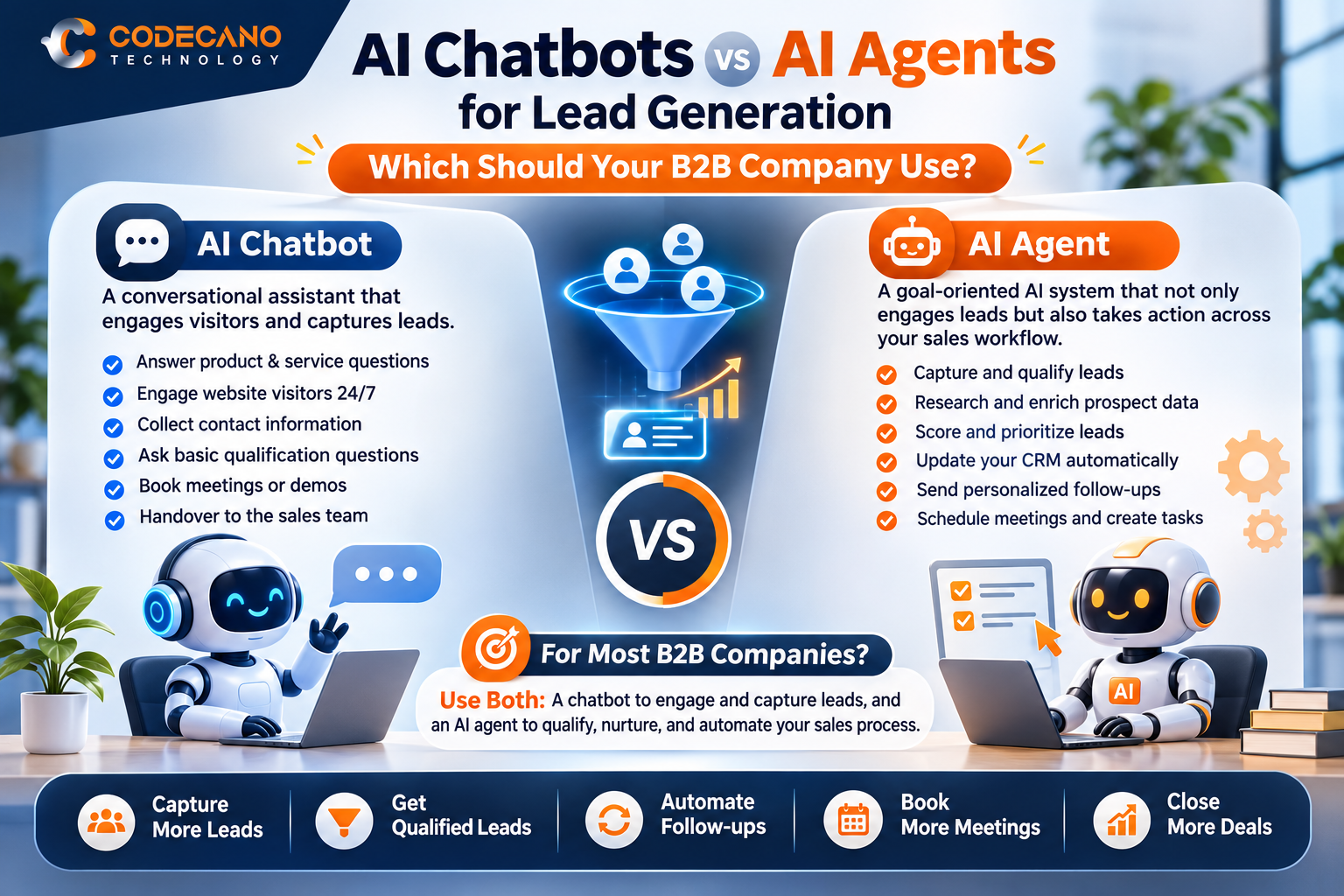
AI chatbots and AI agents are transforming B2B lead generation, but they serve different purposes. Discover how they capture, qualify, nurture, and convert leads, their key differences, and which AI solution your business should implement to build a more efficient sales pipeline.
AI Chatbots vs AI Agents for Lead Generation: Which Should Your B2B Company Use?
Generating high-quality leads is one of the biggest challenges for B2B companies.
Businesses invest heavily in websites, digital marketing, paid advertising, SEO, and outbound sales campaigns. However, generating website traffic is only half the battle. Turning that traffic into qualified business opportunities is where many companies struggle.
Artificial Intelligence is changing this process through two increasingly popular technologies: AI chatbots and AI agents.
While both can improve lead generation, they operate differently and offer different levels of automation.
So, which one should your B2B company use?
Let's explore the differences, practical applications, and how to choose the right solution for your sales strategy.
What Is an AI Chatbot for Lead Generation?
An AI chatbot is a conversational tool designed to interact with potential customers through websites, messaging platforms, or mobile applications.
Its primary purpose is to engage visitors, answer questions, collect contact information, and guide prospects toward the next step in the sales process.
An AI chatbot can:
Engage website visitors 24/7
Answer product and service-related questions
Collect contact information
Understand basic customer requirements
Ask predefined qualification questions
Recommend relevant services
Schedule sales consultations
Transfer conversations to sales representatives
Instead of relying entirely on traditional contact forms, businesses can create interactive experiences that encourage visitors to engage.
Modern AI chatbots can also use large language models and business knowledge bases to provide more personalized and context-aware responses.
However, their primary function is typically conversation and customer interaction.
What Is an AI Agent for Lead Generation?
An AI agent is a goal-oriented AI system capable of analyzing information, selecting actions, using connected tools, and executing multi-step workflows within defined permissions.
Unlike a basic chatbot that primarily communicates with prospects, an AI agent can actively manage multiple stages of the lead generation process.
An AI lead generation agent can:
Identify potential business opportunities
Research prospective companies using approved data sources
Analyze customer requirements
Evaluate prospects against an Ideal Customer Profile (ICP)
Score and prioritize leads
Create personalized follow-up messages
Update CRM records
Schedule meetings
Notify relevant sales representatives
Monitor lead engagement
Trigger lead nurturing workflows
Rather than simply collecting information, an AI agent can use that information to take meaningful action.
Its capabilities depend on the tools, integrations, data access, and permissions provided by the business.
AI Chatbots vs AI Agents: Key Differences
| Feature | AI Chatbot | AI Agent |
|---|---|---|
| Primary purpose | Customer interaction | Goal-oriented task execution |
| Lead capture | Yes | Yes |
| Lead qualification | Conversational or rule-based | Contextual and multi-step |
| Prospect research | Limited or integration-dependent | Can use connected research tools |
| Lead scoring | Usually predefined | Can evaluate multiple data points |
| CRM integration | Supported | Supports multi-step CRM workflows |
| Personalized follow-ups | Template or workflow-based | Context-aware and adaptive |
| Decision-making | Typically constrained | Goal-oriented within defined rules |
| Outbound prospecting | Limited | Possible with approved tools |
| Sales pipeline automation | Partial | More extensive |
| Implementation complexity | Generally lower | Generally higher |
| Human oversight | Recommended | Essential for sensitive actions |
The distinction is not always absolute. Advanced chatbots can execute tasks, and AI agents can communicate through conversational interfaces.
The most important difference is the level of autonomy, workflow execution, and decision-making required.
How AI Chatbots Generate B2B Leads
Traditional B2B websites often depend on contact forms with multiple fields.
However, potential customers may leave without submitting their information if they cannot find immediate answers.
An AI chatbot provides a more interactive alternative.
For example, a visitor arrives on a software development company's website looking for a custom CRM solution.
The chatbot can ask:
What type of business do you operate?
What challenges are you facing with your current CRM?
Which features are you looking for?
What is your expected project timeline?
Would you like to schedule a consultation?
The chatbot collects these details and forwards them to the sales team.
This helps businesses capture opportunities even outside regular working hours while giving prospects a more convenient way to communicate.
How AI Agents Generate B2B Leads
An AI agent can extend the process beyond the initial conversation.
Using the same custom CRM example, an AI agent could:
Understand the prospect's business requirements.
Research the company using authorized public or internal data.
Evaluate whether the company matches the business's ideal customer profile.
Assign a lead score based on predefined qualification criteria.
Create or update the prospect's CRM record.
Prepare a personalized follow-up email.
Check the sales team's calendar availability.
Schedule a consultation after receiving the prospect's confirmation.
Notify the appropriate sales representative.
Prepare a summary of the prospect's requirements before the meeting.
Instead of manually coordinating each activity, the sales team receives a qualified opportunity with relevant business context.
This allows sales professionals to spend more time building relationships, understanding customer needs, and closing deals.
Inbound vs Outbound Lead Generation
B2B companies typically generate leads through two primary channels: inbound and outbound marketing.
Inbound Lead Generation
Inbound lead generation attracts potential customers through:
Search engine optimization
Website content
Paid advertising
Social media marketing
Webinars
Case studies
Product demonstrations
AI chatbots are particularly useful for inbound lead generation because they engage prospects who are already showing interest.
AI agents can extend this process by qualifying, researching, prioritizing, and nurturing those prospects.
Outbound Lead Generation
Outbound lead generation involves proactively identifying and contacting potential customers.
AI agents can assist with:
Identifying target companies
Researching relevant decision-makers
Evaluating prospect suitability
Drafting personalized outreach messages
Managing approved follow-up sequences
Tracking engagement
Updating sales pipelines
Outbound automation must respect applicable privacy regulations, communication laws, platform policies, and opt-out requests.
The goal should be relevant, personalized communication rather than mass-generated spam.
How AI Improves B2B Lead Qualification
Not every lead is a potential customer.
Some prospects may not have the required budget, decision-making authority, business need, or implementation timeline.
An AI-powered lead qualification system can use established frameworks such as BANT.
Budget
Does the prospect have an appropriate budget for the proposed solution?
Authority
Is the prospect a decision-maker or someone involved in the purchasing process?
Need
Does the company have a genuine business problem that your product or service can solve?
Timeline
When does the prospect intend to implement the solution?
A chatbot can collect answers through conversation.
An AI agent can evaluate those answers alongside available company information, CRM history, and engagement signals to help prioritize opportunities.
Businesses can also define qualification criteria based on their Ideal Customer Profile, including industry, company size, geographic market, and service requirements.
The sales team should retain the ability to review and override AI-generated lead scores.
A Practical B2B Lead Generation Example
Imagine a software development agency targeting startup founders, CEOs, and growing businesses.
Without AI
The sales team manually:
Responds to website inquiries
Collects customer requirements
Researches prospective companies
Enters information into the CRM
Sends follow-up emails
Schedules discovery calls
Prepares meeting notes
These activities consume valuable time and can result in missed opportunities.
With an AI Chatbot
The chatbot engages visitors, answers questions, collects project requirements, and forwards inquiries to the sales team.
The sales team still handles research, qualification, follow-ups, and CRM management.
With an AI Agent
The AI agent can analyze requirements, research the prospect, score the lead, update the CRM, prepare personalized follow-ups, and coordinate meetings within approved workflows.
The sales team receives better-organized opportunities and can focus on meaningful sales conversations.
With Both
The chatbot becomes the customer-facing communication layer, while the AI agent manages the underlying qualification and sales automation processes.
This combination creates a connected lead generation system rather than a standalone conversational tool.
Which Industries Can Benefit from AI Lead Generation?
AI-powered lead generation can be implemented across various B2B industries, including:
Software development companies
SaaS businesses
Digital marketing agencies
IT consulting companies
Recruitment agencies
Manufacturing companies
Wholesale and distribution businesses
Logistics companies
Commercial real estate
Financial consulting firms
Professional service providers
Businesses with longer sales cycles, complex customer requirements, or multiple qualification stages may particularly benefit from AI agent-based workflows.
Benefits of AI Chatbots for B2B Companies
AI chatbots offer several advantages for businesses looking to improve inbound lead generation.
24/7 Lead Capture
Potential customers can interact with your business outside regular working hours.
Faster Response Times
Prospects receive immediate answers instead of waiting for a sales representative.
Improved Website Engagement
Conversational experiences can make it easier for visitors to explore services and communicate requirements.
Reduced Sales Workload
Common questions and initial qualification tasks can be handled automatically.
Simpler Implementation
A focused chatbot can often be implemented without redesigning the entire sales infrastructure.
Benefits of AI Agents for B2B Companies
AI agents offer more extensive capabilities for businesses looking to automate their sales operations.
Intelligent Lead Prioritization
AI agents can evaluate multiple qualification signals to help identify promising opportunities.
Automated Lead Nurturing
Follow-ups can be triggered based on prospect behavior, conversation history, and sales pipeline stages.
Personalized Sales Communication
AI agents can prepare relevant messages based on a prospect's industry, business challenges, and requirements.
Connected Sales Operations
AI agents can work across CRM platforms, email systems, calendars, databases, and other business applications.
Improved Sales Productivity
Sales teams can reduce administrative work and dedicate more time to customer relationships and negotiations.
Scalable Lead Management
Businesses can manage growing inquiry volumes without proportionally increasing manual administrative work.
When Should Your B2B Company Use an AI Chatbot?
An AI chatbot may be the right choice if:
Your website receives inquiries that require repetitive responses.
You want to replace traditional contact forms with conversational lead capture.
Your sales team spends significant time answering basic questions.
Your qualification process is relatively straightforward.
You want to improve customer engagement.
You are implementing AI for the first time.
For many small B2B companies, an AI chatbot is a practical starting point.
It addresses immediate lead capture and communication challenges without requiring extensive automation infrastructure.
When Should Your B2B Company Use an AI Agent?
An AI agent may be a better choice if:
Your company generates a high volume of leads.
Your sales team spends significant time researching prospects.
Your lead qualification process involves multiple factors.
Your sales pipeline requires frequent manual updates.
Your business uses multiple disconnected software platforms.
You want to automate personalized follow-ups.
Your sales cycle involves multiple stages and decision-makers.
You need more advanced sales workflow automation.
AI agents are particularly valuable when the bottleneck is not generating inquiries but managing, qualifying, and converting them efficiently.
Why Combining AI Chatbots and AI Agents Is Often the Best Strategy
For many growing B2B companies, choosing between chatbots and AI agents is unnecessary.
Both technologies can work together.
A connected AI-powered lead generation workflow could operate as follows:
Website Visitor → AI Chatbot → AI Agent → Lead Qualification → CRM Update → Personalized Follow-up → Meeting Booking → Sales Team
The chatbot handles conversations.
The AI agent manages research, qualification, and workflow execution.
The sales team handles relationships, complex discussions, negotiations, and closing deals.
This hybrid approach allows businesses to automate repetitive activities while maintaining human involvement where it creates the most value.
How to Implement AI-Powered Lead Generation
Businesses should avoid automating their entire sales process without a clear strategy.
A structured implementation approach is more effective.
Step 1: Define Your Ideal Customer Profile
Identify your target industries, company sizes, geographic markets, decision-makers, and business challenges.
Step 2: Map Your Existing Sales Process
Understand how leads are currently captured, qualified, nurtured, and converted.
Step 3: Identify Automation Opportunities
Find repetitive tasks that consume significant time or create delays.
Step 4: Choose the Right AI Solution
Determine whether a chatbot, AI agent, or hybrid system best addresses your requirements.
Step 5: Integrate Your Business Systems
Connect the AI solution with relevant platforms, such as:
CRM software
Business websites
Email platforms
Calendar systems
Marketing automation tools
Internal knowledge bases
Business databases
Step 6: Establish Security and Human Oversight
Define what information the AI can access, which actions it can perform, and when human approval is required.
Sensitive communications, commercial commitments, pricing negotiations, and unusual requests should be escalated to authorized team members.
Step 7: Measure and Optimize Performance
Monitor performance regularly and refine your qualification criteria, conversations, and automated workflows.
Key Metrics to Measure AI Lead Generation Success
The success of an AI lead generation system should not be measured solely by the number of leads generated.
B2B companies should track:
| Metric | What It Measures |
|---|---|
| Lead Capture Rate | Percentage of visitors who become leads |
| Lead Qualification Rate | Percentage of leads meeting qualification criteria |
| Average Response Time | How quickly prospects receive responses |
| Meeting Booking Rate | Percentage of leads scheduling consultations |
| Meeting Attendance Rate | Percentage of booked meetings attended |
| Sales Qualified Leads (SQLs) | Opportunities accepted by the sales team |
| Lead-to-Customer Conversion Rate | Percentage of leads becoming customers |
| Cost per Qualified Lead | Efficiency of lead generation spending |
| Sales Cycle Length | Time required to convert opportunities |
| Pipeline Value | Potential revenue represented by sales opportunities |
| Sales Team Productivity | Time saved through automation |
The objective is not simply to generate more leads. It is to generate better business opportunities and convert them more efficiently.
Common Mistakes Businesses Make with AI Lead Generation
Focusing on Quantity Instead of Quality
Generating thousands of irrelevant leads creates additional work rather than business value.
Automating Without a Clear Customer Profile
AI cannot consistently identify suitable prospects without well-defined qualification criteria.
Ignoring CRM Integration
Disconnected AI tools can create duplicate records, fragmented information, and inefficient workflows.
Over-Automating Customer Communication
Generic automated messages can damage trust and reduce engagement.
Eliminating Human Oversight
AI-generated information and qualification decisions can be inaccurate. Human review remains important, particularly for high-value opportunities.
Ignoring Data Privacy
Businesses must protect customer information and comply with applicable data protection and communication regulations.
Custom AI Solutions vs Ready-Made Lead Generation Tools
Ready-made AI tools can be useful for businesses with standard lead generation requirements.
However, growing B2B companies often need more specialized functionality, including:
Custom lead qualification logic
Industry-specific workflows
Proprietary business knowledge integration
Advanced CRM integrations
Multi-channel lead management
Custom reporting dashboards
Role-based permissions
Human approval workflows
A custom AI solution allows businesses to build automation around their existing sales processes instead of changing their processes to fit the limitations of a generic tool.
How Codecano Technology Helps B2B Companies Automate Lead Generation
At Codecano Technology, we develop custom AI-powered solutions that help businesses improve lead generation, automate sales operations, and build scalable business workflows.
Our services include:
Custom AI Chatbot Development
AI Agent Development
AI-Powered Lead Generation Systems
Intelligent Lead Qualification
CRM Development and Automation
Sales Workflow Automation
AI-Powered Email Automation
Appointment Scheduling Systems
API and Third-Party Integrations
Custom SaaS Development
AI Integration with Existing Business Software
Whether your business needs a website chatbot, an intelligent lead qualification agent, or a complete AI-powered sales automation system, we help you build a solution aligned with your business objectives.
Stop spending valuable sales time on repetitive administrative tasks. Start building a smarter lead generation system.
Visit www.codecano.com to discuss your AI automation requirements.
Final Thoughts
AI chatbots and AI agents are not necessarily competing technologies. They solve different challenges within the B2B sales process.
AI chatbots help businesses communicate with prospects, capture inquiries, and improve initial engagement.
AI agents extend these capabilities by researching prospects, qualifying opportunities, coordinating follow-ups, and automating connected sales workflows.
If your primary challenge is capturing website inquiries, start with an AI chatbot.
If your challenge is managing, qualifying, and nurturing leads efficiently, consider an AI agent.
If you want to build a comprehensive, scalable B2B lead generation system, combining both technologies may be the most effective approach.
The future of B2B lead generation is not simply about generating more leads.
It's about identifying the right opportunities, engaging them at the right time, and empowering sales teams to close more deals.
Frequently Asked Questions (FAQs)
What is the difference between an AI chatbot and an AI agent for lead generation?
An AI chatbot primarily communicates with prospects and collects information, while an AI agent can analyze information, research prospects, execute tasks, and automate multi-step sales workflows.
Are AI agents better than chatbots for B2B lead generation?
AI agents are generally better suited for complex qualification, prospect research, and sales workflow automation. However, chatbots may be more appropriate for businesses focused on website engagement and inbound lead capture.
Can AI agents automatically qualify leads?
Yes. AI agents can evaluate prospects based on business requirements, company information, engagement history, and predefined qualification criteria. Human review should remain available to validate important decisions.
Can AI chatbots and AI agents work together?
Yes. Chatbots can manage customer conversations while AI agents handle qualification, research, CRM updates, follow-ups, and other connected workflows.
Can AI agents integrate with existing CRM software?
Yes. Depending on available APIs and permissions, AI agents can integrate with platforms such as Salesforce, HubSpot, Zoho CRM, and custom-built CRM systems.
Can AI replace a B2B sales team?
AI can automate many repetitive sales activities, but human sales professionals remain important for relationship building, strategic discussions, negotiations, and complex purchasing decisions.
Is AI-powered lead generation suitable for small B2B companies?
Yes. Small businesses can start with focused chatbot or lead qualification solutions and gradually introduce AI agents as their sales requirements grow.
How much does it cost to build an AI lead generation system?
The development cost depends on the complexity of the qualification process, required integrations, automation workflows, data sources, security requirements, and level of customization. A solution should be designed around the company's specific sales objectives.