Why CEOs Should Invest in Custom Software Instead of Off-the-Shelf Solutions
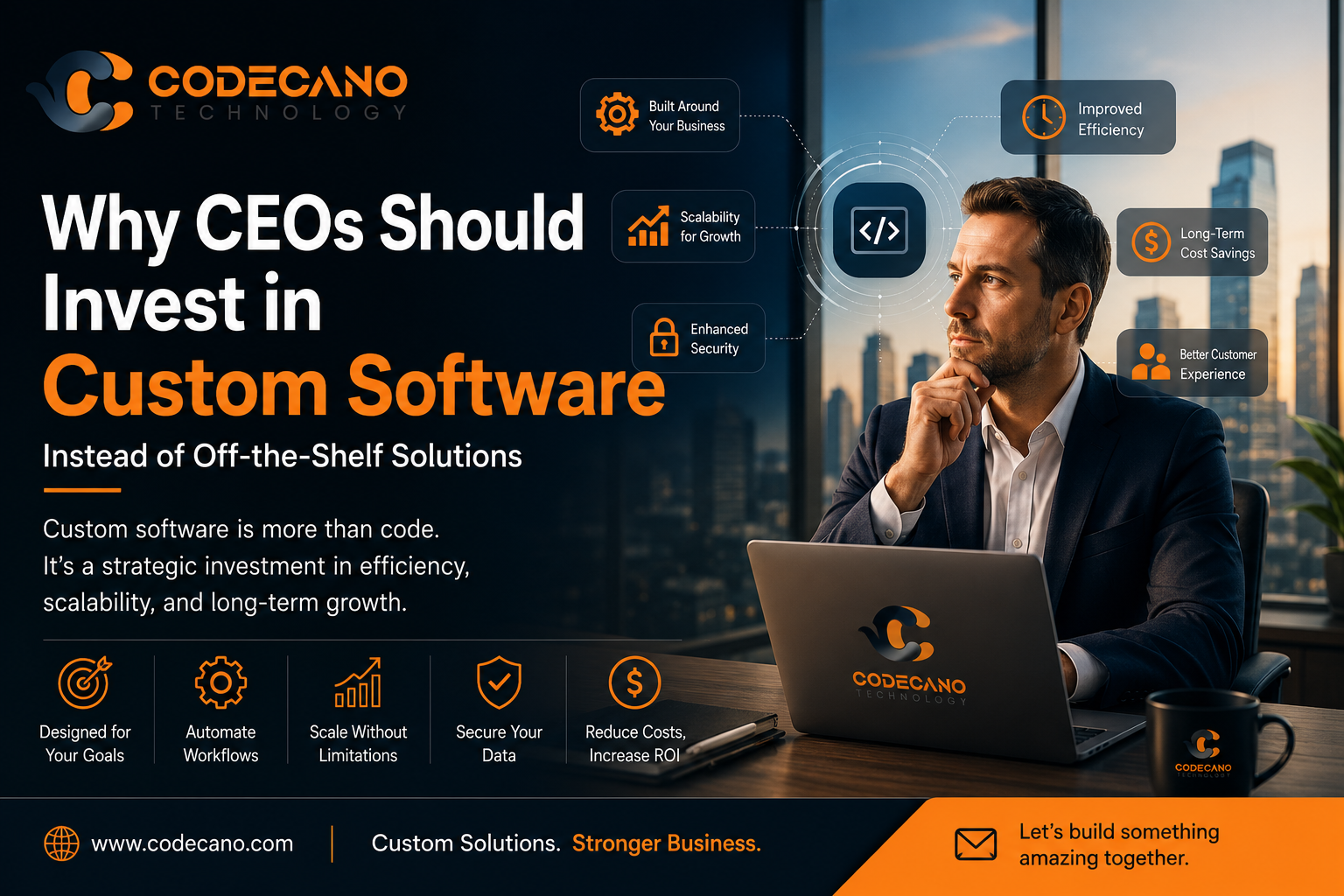
Many businesses rely on off-the-shelf software to manage operations, but as companies grow, these solutions often become expensive, restrictive, and inefficient. Learn why CEOs are increasingly investing in custom software to improve productivity, reduce costs, and gain a competitive advantage.
Why CEOs Should Invest in Custom Software Instead of Off-the-Shelf Solutions
Every growing business reaches a point where generic software starts slowing operations instead of improving them. While off-the-shelf tools are convenient during the early stages, they rarely keep up with evolving business processes, integrations, and scalability requirements.
For CEOs, investing in technology isn't just about digitizing operations—it's about building systems that support long-term growth, improve efficiency, and create competitive advantages.
In this article, we'll explore why more business leaders are moving toward custom software development and when it's the right time for your organization to make the transition.
The Hidden Cost of Off-the-Shelf Software
Many companies choose ready-made software because it's quick to implement and appears cost-effective. However, over time, these tools introduce several challenges:
- Paying monthly subscriptions for features you never use
- Limited customization options
- Difficult integrations with existing systems
- Multiple disconnected applications
- Reduced team productivity
- Vendor lock-in
- Security and compliance limitations
What starts as a $100/month subscription often grows into thousands of dollars each month across multiple departments.
Signs Your Business Has Outgrown Standard Software
Your business may be ready for custom software if you experience any of the following:
1. Teams Are Using Multiple Tools
Sales uses one platform.
Operations use another.
Finance manages everything in spreadsheets.
Management relies on manual reports.
This creates data silos and unnecessary work.
2. Manual Processes Are Increasing
If employees spend hours copying data between systems, generating reports manually, or updating spreadsheets, automation can significantly reduce operational costs.
3. Customers Expect Better Experiences
Modern customers expect:
- Faster service
- Personalized experiences
- Self-service portals
- Mobile accessibility
- Real-time updates
Generic software often limits your ability to deliver these experiences.
4. Reporting Takes Too Long
Executives need accurate data to make decisions.
If your team spends days preparing reports every month, your software is working against your business.
Benefits of Custom Software
Designed Around Your Business
Unlike generic platforms, custom software is built specifically for your workflows.
You decide:
- Features
- User roles
- Approval processes
- Dashboards
- Reports
- Integrations
Your business adapts to the software—not the other way around.
Better Productivity
Employees no longer switch between multiple applications.
Everything is centralized into one platform, reducing errors and saving valuable time.
Scalability
As your company grows, your software grows with it.
Need new modules?
Add them.
Need AI automation?
Integrate it.
Expanding internationally?
Your software can evolve without replacing the entire system.
Improved Security
Custom software allows businesses to implement:
- Role-based permissions
- Multi-factor authentication
- Audit logs
- Data encryption
- Industry-specific compliance
This provides greater control over sensitive business information.
Long-Term Cost Savings
Although custom software requires an initial investment, businesses often save money by:
- Eliminating multiple software subscriptions
- Reducing manual labor
- Improving employee productivity
- Minimizing operational errors
- Increasing customer retention
The return on investment often becomes evident within a few years, especially for businesses with growing operational complexity.
Common Use Cases
Organizations invest in custom software for:
- Customer Relationship Management (CRM)
- Enterprise Resource Planning (ERP)
- Inventory Management
- Booking Systems
- HR Management
- Fleet Management
- Manufacturing Operations
- Healthcare Platforms
- Financial Dashboards
- Business Automation
Choosing the Right Development Partner
Successful software projects require more than developers.
Look for a technology partner that understands:
- Business processes
- Scalability
- Security
- User experience
- Future growth
- AI and automation opportunities
The right partner will recommend solutions that align with your business goals—not just build features.
Final Thoughts
Technology should accelerate business growth, not create operational bottlenecks.
If your organization relies on multiple disconnected tools, manual processes, and inefficient workflows, investing in custom software can provide significant long-term value.
Custom software enables businesses to operate more efficiently, make faster decisions, and create better customer experiences while supporting future growth.
For CEOs focused on building scalable organizations, custom software is not just an IT investment—it's a strategic business decision.