
How to Use AI and Automation to Increase Sales in Your Small Business in 2026
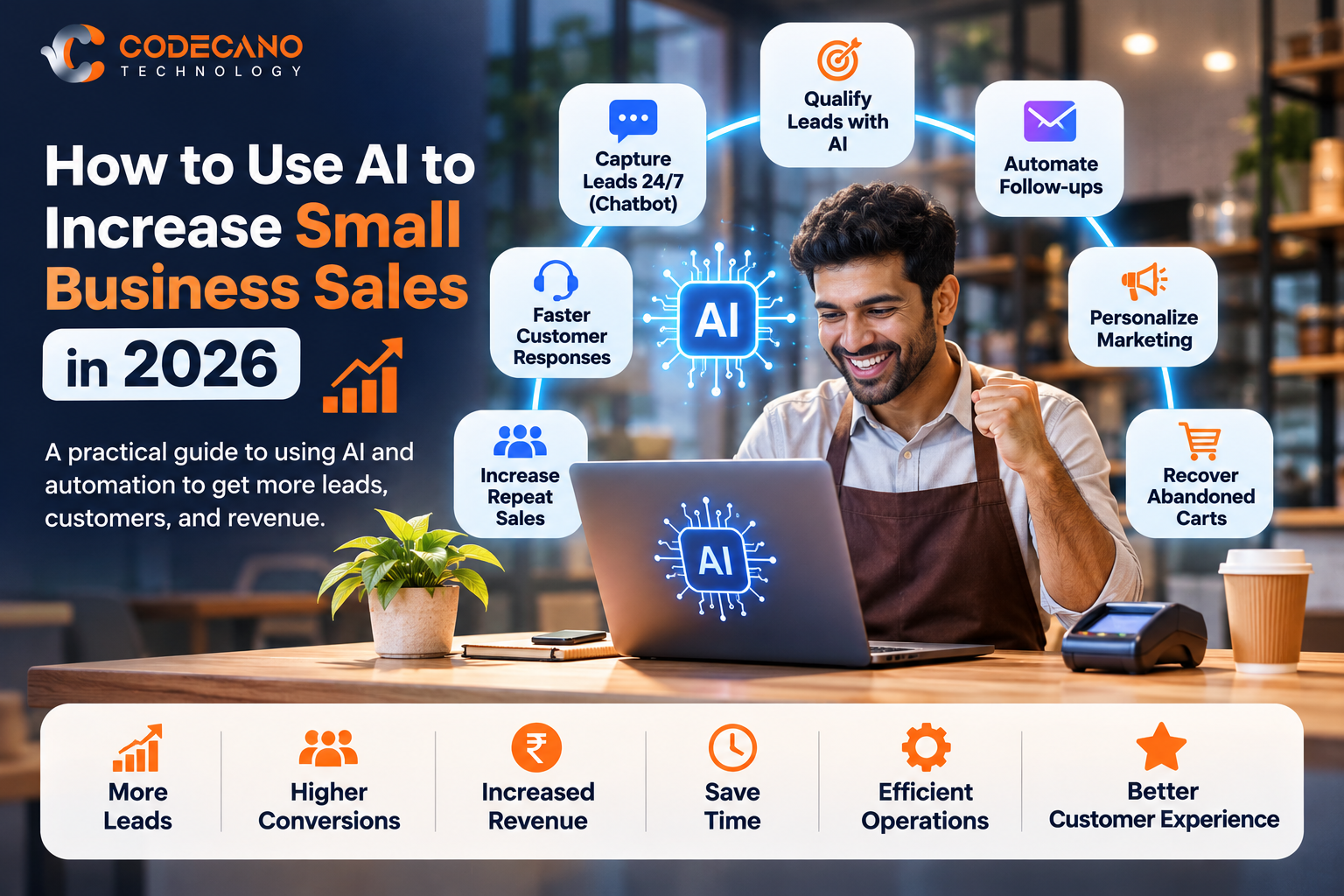
Discover how small businesses can use AI and automation to generate qualified leads, improve customer engagement, automate sales follow-ups, increase conversions, and drive sustainable revenue growth in 2026 without significantly increasing operational costs.
How to Use AI and Automation to Increase Sales in Your Small Business in 2026
Running a small business is becoming increasingly competitive. Customers expect instant responses, personalized experiences, faster service, and seamless purchasing journeys.
However, small businesses often operate with limited resources, smaller teams, and tight marketing budgets.
This is where Artificial Intelligence (AI) and automation can make a significant difference.
From capturing website leads and automating customer follow-ups to predicting customer demand and personalizing marketing campaigns, AI is helping small businesses build more efficient and scalable sales processes.
In 2026, businesses don't necessarily need larger sales teams to increase revenue. They need smarter systems that help their existing teams perform better.
In this guide, we'll explore practical ways to use AI and automation to increase sales, improve customer retention, and accelerate business growth.
Why Small Businesses Need AI and Sales Automation
Many small businesses lose potential sales because of inefficient processes rather than a lack of customer demand.
Common challenges include:
Slow responses to customer inquiries
Missed sales opportunities
Inconsistent customer follow-ups
Poor lead qualification
Manual CRM management
Inefficient marketing campaigns
Limited understanding of customer behavior
Lack of personalized communication
Difficulty retaining existing customers
AI and automation can address these challenges by connecting marketing, sales, customer support, and business operations.
Instead of managing every interaction manually, businesses can create intelligent workflows that operate continuously.
The objective is not simply to automate tasks. It is to create a more efficient system for generating revenue.
AI vs Automation: What's the Difference?
Although AI and automation are closely related, they serve different purposes.
Traditional automation follows predefined rules to perform repetitive tasks.
For example, automatically sending a welcome email whenever a customer submits a contact form.
Artificial Intelligence analyzes information, understands context, generates recommendations, and supports decisions.
For example, analyzing a customer's inquiry to understand their requirements and preparing a personalized sales response.
When combined, AI and automation can create intelligent sales workflows that adapt to customer needs.
| Traditional Automation | AI-Powered Automation |
|---|---|
| Follows predefined rules | Uses context and available data |
| Sends predefined messages | Generates personalized responses |
| Performs repetitive tasks | Supports intelligent decision-making |
| Uses fixed qualification criteria | Evaluates multiple qualification signals |
| Executes structured workflows | Can adapt actions within defined permissions |
Small businesses can benefit from both technologies without implementing unnecessarily complex systems.
12 Ways to Use AI and Automation to Increase Small Business Sales
1. Capture More Leads with AI Chatbots
Many potential customers visit business websites but leave without submitting an inquiry.
Traditional contact forms require visitors to take the initiative, while AI chatbots can provide immediate assistance.
An AI-powered chatbot can:
Engage website visitors
Answer product and service questions
Understand customer requirements
Collect contact information
Recommend relevant products or services
Schedule consultations
Transfer qualified inquiries to the sales team
For example, a software development company can use an AI chatbot to understand whether a visitor needs a website, mobile application, CRM, or custom software solution.
The chatbot can collect project requirements and forward the information to the appropriate sales representative.
This helps businesses capture opportunities outside regular working hours and reduce missed inquiries.
2. Automate Lead Qualification with AI Agents
Not every inquiry represents a genuine sales opportunity.
Manually reviewing every lead can consume significant time, particularly for businesses receiving inquiries through multiple channels.
AI agents can assist by evaluating leads based on:
Customer requirements
Business type
Budget expectations
Purchase intent
Project timeline
Previous interactions
Ideal Customer Profile
Qualified leads can be prioritized and assigned to sales representatives.
Lower-priority leads can enter appropriate nurturing workflows instead of being ignored.
This allows sales teams to focus their attention on opportunities with stronger potential.
3. Respond to Customer Inquiries Faster
Customers frequently contact multiple businesses before making a purchasing decision.
A delayed response can result in a lost opportunity.
AI-powered communication systems can assist customers through:
Website live chat
WhatsApp Business
Email
Facebook Messenger
Customer support portals
These systems can answer common questions, provide product information, explain services, and collect additional requirements.
Complex inquiries can be escalated to human representatives.
Faster and more relevant responses can help businesses build trust and improve the likelihood of conversion.
4. Automate Sales Follow-Ups
One of the most common reasons businesses lose leads is inconsistent follow-up.
A potential customer may be interested in a product or service but not ready to purchase immediately.
Instead of relying on sales representatives to remember every follow-up, businesses can automate the process.
A sales automation workflow could include:
Immediate acknowledgment after an inquiry
A personalized introduction
A reminder if the customer has not responded
Relevant case studies or product information
A consultation invitation
A final follow-up message
AI can help personalize these messages based on customer requirements and previous conversations.
Businesses should establish reasonable follow-up frequencies and respect customer communication preferences and opt-out requests.
5. Personalize Marketing Campaigns
Generic marketing campaigns often fail because customers have different needs and purchasing behaviors.
AI can help businesses segment their audiences based on:
Purchase history
Customer interests
Website behavior
Previous inquiries
Product preferences
Engagement levels
Businesses can then create more relevant marketing campaigns for each customer segment.
For example, an eCommerce store can send product recommendations based on previous purchases, while a service-based business can share relevant solutions based on a customer's inquiry history.
Personalized communication can improve engagement and encourage customers to take action.
6. Automate WhatsApp Marketing
WhatsApp can be an effective communication channel for small businesses, particularly those that regularly interact with customers through messaging.
With WhatsApp Business Platform integrations, businesses can automate:
Inquiry responses
Product recommendations
Appointment reminders
Order confirmations
Payment reminders
Promotional campaigns
Customer feedback requests
Re-engagement messages
For example, a beauty salon can automatically remind customers when they may be due for their next appointment.
A retail business can notify interested customers when a product becomes available again.
These workflows can help businesses generate repeat sales while maintaining consistent communication.
Businesses must obtain appropriate customer consent and follow WhatsApp's messaging policies, including applicable template and messaging-window requirements.
7. Recover Abandoned Shopping Carts
Many online shoppers add products to their carts but leave without completing their purchases.
AI and automation can help businesses reconnect with these customers through appropriate communication channels.
An automated cart recovery workflow can:
Send a reminder about abandoned products
Answer common purchasing questions
Provide relevant product information
Offer customer support
Recommend alternative products
Apply an approved promotional offer when appropriate
AI can also help businesses analyze patterns behind cart abandonment, such as unexpected shipping costs, complicated checkout processes, or limited payment options.
The goal is to remove purchasing barriers rather than simply send more reminders.
8. Increase Sales Through AI-Powered Recommendations
Product recommendations can help customers discover relevant products and services.
AI recommendation systems can analyze:
Purchase history
Browsing behavior
Product relationships
Customer preferences
Frequently purchased combinations
Businesses can use these insights to implement cross-selling and upselling strategies.
For example:
A clothing store recommends matching accessories.
A restaurant recommends complementary menu items.
A software company recommends relevant integrations.
A digital agency suggests SEO services alongside website development.
A SaaS platform recommends an appropriate subscription upgrade.
Relevant recommendations can improve the customer experience while increasing average order value.
Recommendations should focus on genuine customer needs rather than unnecessary purchases.
9. Automate CRM and Sales Pipeline Management
Customer Relationship Management (CRM) software plays an important role in managing sales opportunities.
However, many small businesses still rely on spreadsheets, notebooks, or disconnected communication platforms.
AI-powered CRM automation can help businesses:
Automatically create lead records
Update customer information
Track sales conversations
Assign leads to representatives
Generate follow-up reminders
Identify inactive opportunities
Summarize customer requirements
Monitor sales pipeline performance
Prepare meeting summaries
When customer information is centralized, sales teams can better understand each opportunity and avoid losing important details.
AI agents can extend these capabilities by coordinating workflows across websites, CRM systems, email platforms, and calendars.
10. Improve Advertising Performance with AI
Small businesses often invest in Google Ads, Facebook Ads, Instagram Ads, and other digital marketing channels.
However, generating clicks does not necessarily generate profitable sales.
AI can assist businesses with:
Audience segmentation
Advertising creative development
Campaign performance analysis
Conversion tracking
Landing page optimization
Identifying underperforming campaigns
Analyzing customer acquisition costs
Budget allocation recommendations
Businesses can also connect advertising platforms with their CRM systems to understand which campaigns generate qualified leads and paying customers.
This allows marketing decisions to focus on business outcomes rather than impressions and clicks alone.
AI-generated recommendations should be reviewed before making significant advertising budget changes.
11. Increase Customer Retention with AI
Generating new customers is important, but retaining existing customers is equally valuable.
AI can help businesses identify customers who may be ready to purchase again or who have stopped engaging.
Automated retention workflows can include:
Subscription renewal reminders
Product replenishment notifications
Personalized loyalty offers
Customer satisfaction surveys
Service renewal reminders
Relevant product recommendations
Re-engagement campaigns
For example, a SaaS company can identify customers who have stopped using important product features and offer assistance before their subscription expires.
A service-based business can remind existing customers when maintenance or renewal services are due.
Improving customer retention can support more predictable revenue growth.
12. Use AI Analytics to Make Better Sales Decisions
Every business generates valuable sales and customer data.
However, collecting data is not enough. Businesses need to understand what that data means.
AI-powered analytics can help identify:
Best-selling products
High-performing marketing channels
Customer purchasing patterns
Seasonal demand trends
Underperforming products
Sales conversion bottlenecks
Customer retention opportunities
Potential revenue trends
Instead of manually reviewing multiple spreadsheets, business owners can use intelligent dashboards and AI assistants to explore their business performance.
These insights can support better decisions about marketing, inventory, pricing, customer engagement, and sales strategy.
AI-generated forecasts should be treated as estimates rather than guaranteed outcomes.
A Practical AI-Powered Sales Workflow for Small Businesses
Imagine a small B2B company offering professional services.
A potential customer discovers the company through Google Ads and visits its website.
An AI-powered sales workflow could operate as follows:
The website chatbot engages the visitor.
The chatbot understands the customer's requirements.
Contact information is collected with appropriate consent.
An AI agent evaluates the lead against qualification criteria.
The lead is automatically added to the CRM.
A personalized follow-up email is prepared or sent through an approved workflow.
The customer receives an invitation to schedule a consultation.
The meeting is booked after confirmation.
The sales representative receives a summary of the customer's requirements.
Follow-up tasks are created based on the meeting outcome.
The sales team manages negotiations and closes the opportunity.
Customer onboarding and retention workflows are initiated after the sale.
This connected system reduces repetitive administrative work while maintaining human involvement in important commercial decisions.
Instead of spending hours managing individual tasks, the sales team can focus on understanding customers and closing deals.
How Different Small Businesses Can Use AI to Increase Sales
AI automation is not limited to technology companies.
Different industries can implement AI according to their specific business requirements.
| Business Type | AI and Automation Use Cases |
|---|---|
| Retail Stores | Product recommendations, loyalty programs, inventory forecasting |
| Restaurants | Repeat-order campaigns, customer feedback, menu recommendations |
| eCommerce | Cart recovery, personalized offers, customer support |
| Software Companies | Lead qualification, CRM automation, consultation booking |
| Real Estate | Property recommendations, inquiry qualification, visit scheduling |
| Beauty Salons and Spas | Appointment reminders, repeat booking campaigns |
| Professional Services | Inquiry management, proposal assistance, automated follow-ups |
| Manufacturing | B2B prospect research, quotation workflows, demand forecasting |
| SaaS Companies | Customer onboarding, subscription renewals, retention analysis |
| Education Businesses | Course inquiries, enrollment assistance, student communication |
The best AI solution is one that addresses a measurable business challenge rather than simply introducing new technology.
Which AI Tools Should Small Businesses Use?
Small businesses can implement different categories of AI and automation tools depending on their sales requirements.
AI Assistants
Tools such as ChatGPT, Claude, and Gemini can assist with sales communication, content creation, customer research, and business analysis.
CRM Platforms
Platforms such as HubSpot, Salesforce, and Zoho CRM can help businesses manage customer relationships, track opportunities, and automate sales activities.
Workflow Automation Platforms
Tools such as n8n, Make, and Zapier can connect business applications and automate repetitive processes.
AI Chatbots and AI Agents
Custom or ready-made AI chatbots and agents can support customer communication, lead qualification, and multi-step sales workflows.
Marketing Automation Platforms
Businesses can use email marketing, WhatsApp Business integrations, and advertising automation tools to manage customer engagement.
Custom AI-Powered Software
Businesses with specialized requirements may benefit from custom AI applications that integrate directly with their existing systems.
The right combination depends on your business model, existing software, technical requirements, and growth objectives.
Ready-Made AI Tools vs Custom AI Automation
Many small businesses begin with ready-made AI tools because they are relatively straightforward to implement.
However, as business requirements become more complex, generic solutions may introduce limitations.
| Ready-Made AI Tools | Custom AI Solutions |
|---|---|
| Faster initial implementation | Designed around business requirements |
| Standard features | Customized functionality |
| Predefined integrations | Flexible system integrations |
| Limited workflow customization | Business-specific automation |
| Vendor-defined data controls | Configurable data and access controls |
| Suitable for common use cases | Suitable for specialized processes |
Custom AI solutions may be particularly valuable when a business needs to connect multiple systems, implement specialized lead qualification logic, or automate industry-specific sales processes.
Businesses should evaluate development, maintenance, security, integration, and long-term operational requirements before choosing an approach.
How to Implement AI and Automation in Your Small Business
Implementing AI does not require transforming your entire business at once.
A phased approach can help reduce implementation risks and identify measurable improvements.
Step 1: Identify Your Biggest Sales Bottleneck
Determine where your business is losing opportunities.
Are customers waiting too long for responses? Are leads being ignored? Are existing customers failing to return?
Start with the problem that has the greatest potential business impact.
Step 2: Map Your Customer Journey
Understand how customers discover your business, communicate with your team, evaluate products or services, make purchases, and return for future transactions.
Identify opportunities where automation can improve the experience.
Step 3: Select Repetitive Tasks
Prioritize activities such as:
Responding to common inquiries
Lead qualification
Follow-up communication
CRM updates
Appointment scheduling
Customer retention campaigns
Step 4: Choose the Right Technology
Determine whether your business needs traditional automation, an AI chatbot, an AI agent, a CRM integration, or a custom AI application.
Not every task requires Artificial Intelligence. Rule-based automation may be more reliable and cost-effective for predictable processes.
Step 5: Connect Your Business Systems
Integrate your website, CRM, communication platforms, calendars, payment systems, and other relevant applications.
A connected system reduces fragmented data and duplicate work.
Step 6: Establish Human Oversight
Define which activities AI can perform independently and which require human approval.
Pricing commitments, contract negotiations, refunds, sensitive customer requests, and significant financial decisions should have appropriate controls.
Step 7: Measure Results and Expand
Monitor performance before and after implementation.
Once the initial automation delivers measurable value, gradually expand into additional business processes.
A 90-Day AI Sales Automation Roadmap
Small businesses can use the following illustrative roadmap to begin implementing AI and automation.
Days 1–30: Build the Foundation
Analyze your existing sales process.
Identify missed opportunities.
Define your ideal customer profile.
Organize customer and sales data.
Implement basic lead capture automation.
Establish baseline sales performance metrics.
Days 31–60: Automate Sales Operations
Implement an AI-powered chatbot where appropriate.
Connect lead capture with your CRM.
Automate customer follow-ups.
Introduce appointment scheduling workflows.
Implement customer segmentation.
Test and refine automated communications.
Days 61–90: Optimize and Scale
Introduce AI-powered lead qualification where justified.
Analyze conversion performance.
Improve customer retention workflows.
Optimize marketing campaigns.
Implement intelligent sales reporting.
Expand successful automation processes.
The actual implementation timeline will depend on your existing infrastructure, business requirements, data quality, and integration complexity.
Key Metrics to Measure AI Sales Performance
Businesses should evaluate AI automation based on measurable outcomes rather than the number of automated tasks.
| Metric | What It Measures |
|---|---|
| Lead Conversion Rate | Percentage of leads becoming customers |
| Lead Qualification Rate | Percentage of inquiries meeting sales criteria |
| Average Response Time | Speed of customer communication |
| Customer Acquisition Cost | Cost of acquiring a new customer |
| Average Order Value | Average revenue per transaction |
| Customer Lifetime Value | Estimated long-term value of a customer |
| Repeat Purchase Rate | Percentage of customers purchasing again |
| Cart Recovery Rate | Percentage of abandoned carts converted into purchases |
| Sales Cycle Length | Time required to convert a lead |
| Revenue Growth | Changes in business revenue |
| Sales Team Productivity | Time and effort saved through automation |
| Automation ROI | Financial value generated relative to automation costs |
These metrics help businesses understand whether AI is improving sales performance or simply adding another layer of technology.
How to Calculate the ROI of AI and Automation
Before investing in AI, small businesses should understand the potential return on investment.
A basic calculation is:
Automation ROI = ((Financial Benefits − Automation Costs) ÷ Automation Costs) × 100
Financial benefits may include:
Additional gross profit from increased sales
Reduced administrative expenses
Lower customer acquisition costs
Reduced operational inefficiencies
Improved customer retention
Realized savings from reduced manual work
Automation costs may include software subscriptions, development, integrations, maintenance, infrastructure, and employee training.
Businesses should avoid counting the same financial benefit twice or treating additional revenue as pure profit.
The objective is to determine whether automation creates sustainable financial value.
Common Mistakes Small Businesses Make with AI Automation
Automating Everything at Once
Introducing too many systems simultaneously can increase complexity and disrupt existing operations.
Start with a focused use case and expand gradually.
Using AI Without Clear Business Objectives
AI implementation should address a specific business challenge.
Technology adoption alone does not guarantee increased sales.
Ignoring Data Quality
AI systems depend on accurate and relevant information.
Incomplete CRM records, outdated product information, and inconsistent customer data can reduce effectiveness.
Sending Excessive Automated Messages
Too many automated emails or WhatsApp messages can damage customer relationships.
Communication should be relevant, timely, and permission-based.
Removing Human Interaction Completely
Customers may still prefer speaking with a real person, particularly when making complex or high-value purchasing decisions.
AI should support customer relationships rather than create unnecessary barriers.
Ignoring Security and Customer Privacy
Businesses must protect customer information, manage access permissions, and comply with applicable privacy and communication regulations.
Measuring Activity Instead of Results
Sending more emails or generating more leads does not necessarily mean increased revenue.
Focus on qualified opportunities, conversions, customer retention, profitability, and business growth.
How Codecano Technology Helps Small Businesses Increase Sales with AI
At Codecano Technology, we help businesses implement practical AI and automation solutions designed around their existing operations and growth objectives.
Rather than forcing businesses to adapt to generic software, we develop solutions that address their specific challenges.
Our services include:
Custom AI Chatbot Development
AI Agent Development
AI-Powered Lead Generation Systems
Sales and Marketing Automation
CRM Development and Automation
WhatsApp Business API Integration
Customer Support Automation
Intelligent Workflow Automation
eCommerce Automation
AI-Powered Analytics Dashboards
Custom SaaS Development
API and Third-Party Integrations
AI Integration with Existing Business Software
Whether you operate a small retail business, a growing startup, a B2B company, or an eCommerce platform, we help you build connected systems that support efficient and scalable growth.
Our approach focuses on understanding your business processes, identifying automation opportunities, and developing technology that delivers measurable value.
Your business doesn't necessarily need more manual work to generate more sales. It needs smarter systems.
Visit www.codecano.com to discuss how AI and automation can help your business grow.
Final Thoughts
AI and automation are changing how small businesses generate leads, communicate with customers, manage sales pipelines, and build long-term customer relationships.
The biggest opportunity is not simply automating repetitive tasks. It is creating a connected business ecosystem where marketing, sales, customer support, and operations work together.
Small businesses that implement AI strategically can improve efficiency, reduce missed opportunities, and create better customer experiences.
You don't need to automate your entire business immediately.
Start with one sales bottleneck.
Implement the right solution.
Measure the results.
Then expand.
In 2026, the question is no longer whether small businesses can benefit from AI.
The question is which business processes they should automate first to achieve sustainable sales growth.
Frequently Asked Questions (FAQs)
How can AI increase sales in a small business?
AI can help increase sales by improving lead capture, qualifying prospects, personalizing marketing campaigns, automating follow-ups, recommending products, and improving customer retention.
What is the best AI automation for small businesses?
The best automation depends on your business requirements. Customer support chatbots, lead qualification, CRM automation, appointment scheduling, and sales follow-ups are practical starting points.
Can AI generate leads automatically?
Yes. AI-powered systems can capture website inquiries, identify potential prospects using approved data sources, qualify leads, and support personalized outreach workflows.
Can AI help small businesses without a large marketing budget?
Yes. Small businesses can start with focused AI solutions that address specific challenges and gradually expand based on measurable results.
Can AI automate WhatsApp marketing?
Yes. Businesses can use WhatsApp Business Platform integrations to automate customer communication, appointment reminders, approved marketing campaigns, and follow-ups while complying with platform policies.
Can AI replace my sales team?
AI can automate repetitive sales activities, but human sales professionals remain important for relationship building, negotiations, complex consultations, and strategic decisions.
How long does it take to see results from AI automation?
The timeline depends on the complexity of the implementation, existing sales processes, customer demand, data quality, and the selected automation strategy. Businesses should establish baseline metrics and measure improvements over time.
Can AI integrate with my existing business software?
Yes. Depending on available APIs and permissions, AI solutions can integrate with CRM systems, ERP software, websites, eCommerce platforms, accounting applications, and communication tools.
Is custom AI automation better than ready-made software?
Custom AI automation may be more suitable for businesses with specialized workflows and integration requirements. Ready-made software can be effective for businesses with standard automation needs.
How much does AI automation cost for a small business?
The cost depends on business requirements, workflow complexity, integrations, infrastructure, AI models, and customization. Businesses should evaluate potential ROI and long-term operational costs before selecting a solution.