7 Mistakes First-Time Startup Founders Make When Hiring Developers
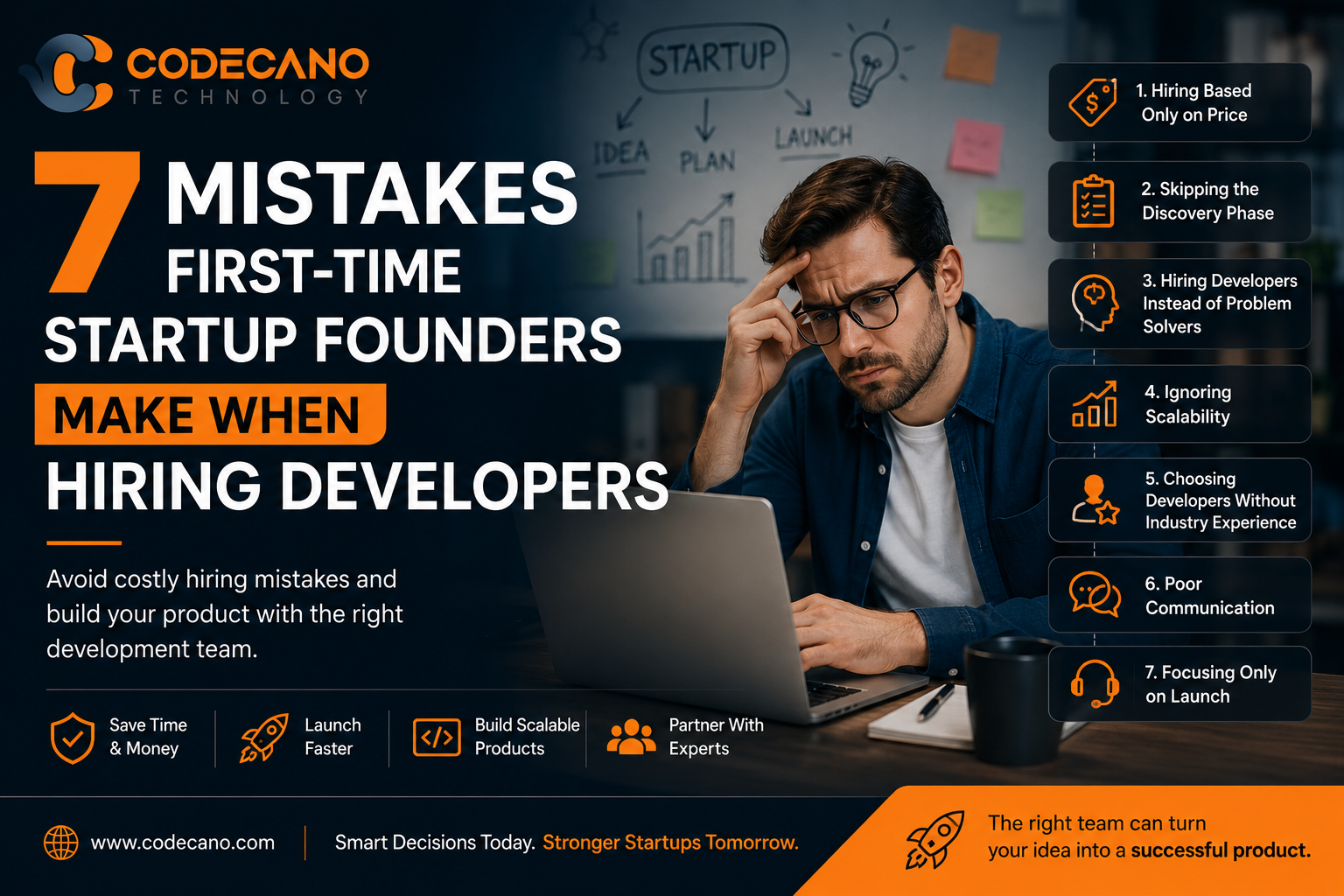
Hiring the wrong development team can cost your startup months of progress and thousands of dollars. Learn the seven most common hiring mistakes first-time founders make and how to build a successful product with the right development partner.
7 Mistakes First-Time Startup Founders Make When Hiring Developers
For many first-time startup founders, hiring developers is one of the biggest and most important decisions they'll make.
Your development team doesn't just write code—they shape your product, influence your launch timeline, and directly impact your startup's future.
Unfortunately, many founders hire based on price alone, skip technical planning, or choose the wrong development partner, leading to missed deadlines, poor product quality, and unnecessary expenses.
If you're planning to build an MVP, SaaS platform, mobile app, or custom software, avoiding these common mistakes can save you significant time, money, and frustration.
Mistake #1: Hiring Based Only on the Lowest Price
Every founder wants to manage costs, especially in the early stages. However, choosing the cheapest developer often results in higher costs later.
Low-cost developers may:
- Deliver poor-quality code
- Miss deadlines
- Lack scalability planning
- Ignore security best practices
- Require complete rewrites
Remember:
Cheap development often becomes expensive maintenance.
Instead of asking:
"Who is the cheapest?"
Ask:
"Who can build a product that supports my business goals?"
Mistake #2: Skipping the Discovery Phase
Many founders rush directly into development.
Without proper planning, developers are forced to make assumptions, resulting in:
- Missing features
- Scope creep
- Budget overruns
- Poor user experience
Before writing a single line of code, define:
- Business objectives
- Target audience
- User journey
- Core features
- MVP scope
- Future roadmap
A clear product strategy reduces both development time and risk.
Mistake #3: Hiring Developers Instead of Problem Solvers
Coding is only part of software development.
Great developers ask questions like:
- Why does this feature exist?
- Can this process be simplified?
- Is there a better user experience?
- Can automation replace manual work?
The best development partners think like product consultants, not just programmers.
Mistake #4: Ignoring Scalability
Many startups build software only for today's users.
Successful startups build for tomorrow.
Your application should support:
- Increased users
- New features
- Third-party integrations
- Mobile applications
- AI capabilities
- International expansion
Rebuilding your platform after growth is far more expensive than planning for scalability from the beginning.
Mistake #5: Choosing Developers Without Industry Experience
Every industry has unique workflows and compliance requirements.
For example:
- Healthcare requires data privacy.
- Fintech demands strong security.
- E-commerce needs payment integrations.
- Logistics depends on real-time tracking.
- Education platforms require course management.
Choose a development partner that understands your business domain—not just your preferred programming language.
Mistake #6: Poor Communication
One of the biggest reasons startup projects fail isn't technical—it's communication.
Common warning signs include:
- Slow responses
- No weekly progress updates
- Unclear timelines
- No project documentation
- Lack of transparency
Professional development teams provide:
- Weekly demos
- Sprint planning
- Progress reports
- Project management tools
- Dedicated points of contact
Clear communication keeps projects on schedule and reduces surprises.
Mistake #7: Focusing Only on Launch
Launching your product is just the beginning.
After launch, you'll likely need:
- Bug fixes
- Performance improvements
- Security updates
- Feature enhancements
- Customer feedback implementation
- Infrastructure scaling
Before hiring, ask:
- Do they provide long-term support?
- How quickly do they resolve issues?
- Can they scale the development team as the business grows?
Choosing a long-term technology partner is often more valuable than hiring developers for a one-time project.
What You Should Look for Instead
Rather than hiring based solely on hourly rates, evaluate developers on:
Technical Expertise
Can they build scalable web and mobile applications?
Product Thinking
Do they understand startups, MVPs, and business goals?
Communication
Will they keep you informed throughout the project?
Security
Do they follow modern security standards?
Scalability
Can your application grow with your business?
Support
Will they remain available after launch?
Questions Every Founder Should Ask Before Hiring
Before signing a contract, ask:
- Have you built products similar to mine?
- What technology stack do you recommend and why?
- How do you manage projects?
- What happens if requirements change?
- Who owns the source code?
- How is intellectual property protected?
- Do you provide maintenance after launch?
- Can you help scale the product in the future?
The answers will tell you far more than a pricing proposal ever could.
Final Thoughts
Hiring developers is one of the most strategic investments a startup founder can make.
The right team doesn't just build software—they help validate ideas, improve user experiences, reduce technical risks, and accelerate your path to market.
Take the time to choose a development partner who understands your vision, communicates transparently, and builds with long-term growth in mind.
A successful startup isn't built by writing more code—it's built by making smarter decisions from day one.
Why Work with Codecano Technology?
At Codecano Technology, we help startups transform ideas into scalable digital products. From MVP development and SaaS platforms to custom web and mobile applications, our team works as an extension of your business—not just a coding vendor.
Whether you're validating your first idea or preparing to scale, we focus on building secure, maintainable, and growth-ready solutions that align with your startup's goals.
Need a technical partner for your startup? Let's build your product the right way.