
MVP vs Full Product: What Should You Build First?
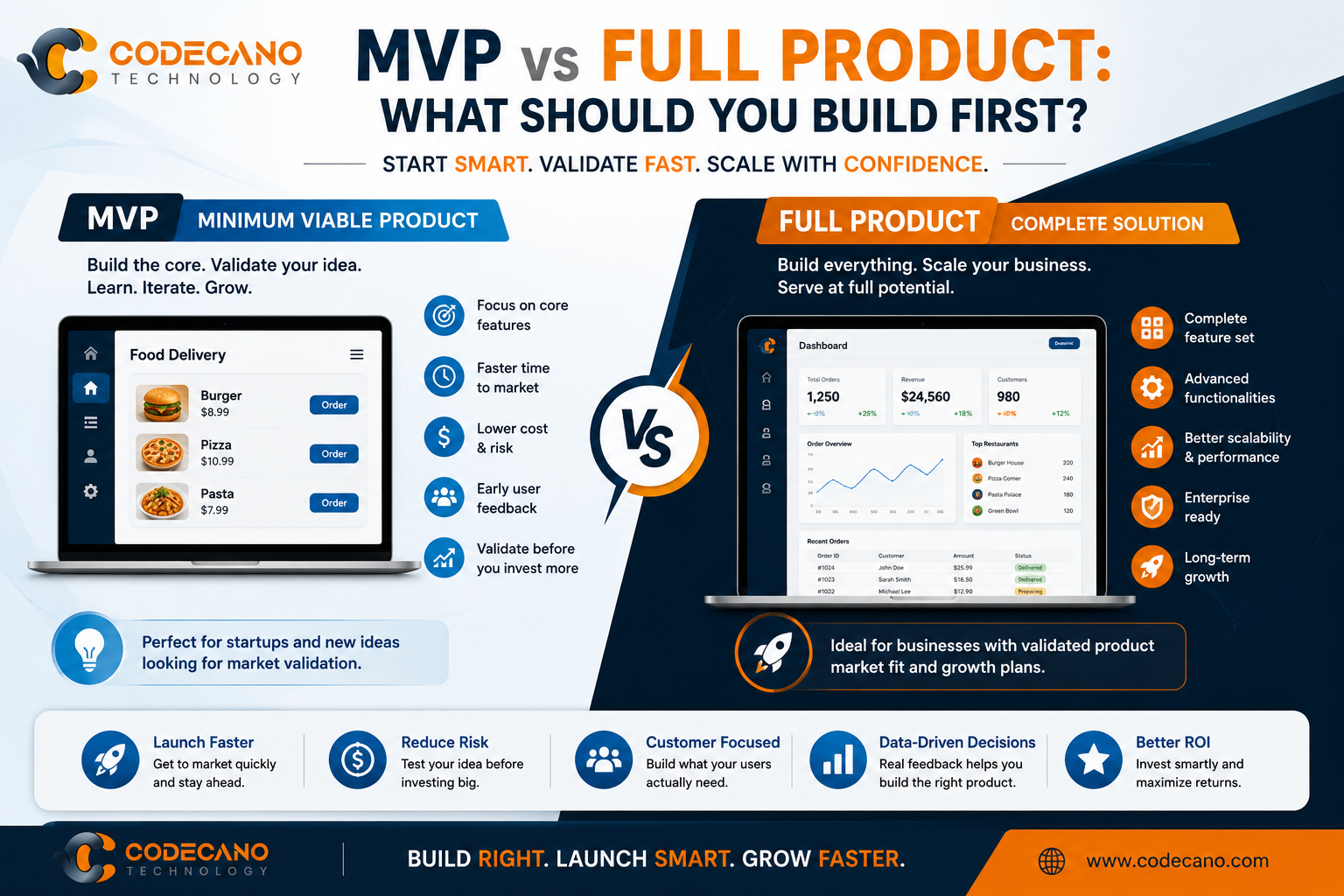
Should you launch a Minimum Viable Product (MVP) or build a full-featured product from day one? Discover the pros, cons, costs, and strategic advantages of each approach to make the right decision for your startup.
MVP vs Full Product: What Should You Build First?
Every startup founder faces the same critical question before writing the first line of code:
Should we build an MVP first or launch the complete product?
It's an important decision because it affects your budget, time-to-market, customer feedback, and even your chances of securing investment.
Many first-time founders believe they need a polished, feature-rich product before launching. In reality, some of the world's most successful companies started with simple MVPs that solved one core problem exceptionally well.
In this guide, we'll compare MVPs and full products to help you decide which approach is right for your business.
What Is an MVP?
An MVP (Minimum Viable Product) is the simplest version of your product that delivers value to early users.
Instead of building every feature you envision, an MVP focuses only on the essential functionality needed to validate your idea.
Its primary goal is to answer one question:
"Will customers actually use and pay for this solution?"
Example
Imagine you're building a food delivery platform.
MVP
- User Registration
- Restaurant Listings
- Food Ordering
- Online Payments
- Order Tracking
Full Product
- AI Recommendations
- Loyalty Program
- Referral System
- Coupons
- Driver App
- Restaurant Dashboard
- Customer Support Chat
- Analytics
- Multi-language Support
- Subscription Plans
Notice how the MVP solves the core problem without unnecessary complexity.
What Is a Full Product?
A full product includes all planned features, advanced workflows, integrations, automation, analytics, and scalability components.
It is designed for long-term operations rather than early validation.
A complete product often requires:
- Larger budgets
- Bigger development teams
- Longer timelines
- Extensive testing
- Ongoing maintenance
MVP vs Full Product Comparison
| Feature | MVP | Full Product |
|---|---|---|
| Development Time | 2–4 Months | 8–18 Months |
| Initial Cost | Low | High |
| Risk | Lower | Higher |
| Customer Feedback | Early | Delayed |
| Market Validation | Fast | Slow |
| Investor Readiness | Excellent | Depends |
| Feature Set | Essential | Comprehensive |
| Time to Revenue | Faster | Slower |
Why Startups Should Build an MVP First
1. Validate Your Idea
The biggest risk for startups isn't poor development.
It's building something nobody wants.
Launching an MVP lets you test market demand before investing heavily.
Instead of relying on assumptions, you'll collect real user feedback.
2. Save Development Costs
Building unnecessary features consumes both time and money.
By focusing only on essential functionality, founders can significantly reduce their initial investment while creating a product users can actually test.
3. Launch Faster
Speed matters.
The sooner your product reaches customers, the sooner you'll learn:
- What users like
- What users ignore
- Which features matter most
- What customers are willing to pay for
Early feedback is often more valuable than months of internal planning.
4. Attract Investors
Investors prefer startups with traction rather than just ideas.
An MVP demonstrates:
- Customer interest
- Product validation
- User engagement
- Revenue potential
- Market demand
These metrics strengthen your fundraising efforts.
5. Reduce Business Risk
Every feature built without customer validation increases risk.
An MVP minimizes wasted development by ensuring you're solving the right problem before expanding your product.
When Should You Build a Full Product?
A full-featured product makes sense when:
- You already have validated demand.
- Your business model is proven.
- You have paying customers.
- Funding has been secured.
- Your product roadmap is well-defined.
- Your team is ready to scale.
At this stage, investing in advanced functionality becomes a strategic growth decision rather than a speculative one.
Common Mistakes Founders Make
Building Too Many Features
Many startups delay launch because they keep adding "just one more feature."
Perfection often becomes the enemy of progress.
Ignoring Customer Feedback
Some founders spend months building features customers never requested.
Successful startups build with customers—not for customers.
Overengineering
Your first product doesn't need:
- AI
- Complex dashboards
- Enterprise-level architecture
- Multiple integrations
- Advanced analytics
Start simple.
Scale intelligently.
How to Decide What Goes Into Your MVP
Ask yourself:
Does this feature solve the primary problem?
If not, remove it.
Will customers pay without this feature?
If yes, leave it for later.
Is it essential for launch?
If not, add it to your future roadmap.
A Simple MVP Framework
Your MVP should include only four things:
Core Feature
The primary reason customers use your product.
Authentication
User registration and login.
Payments (if applicable)
Allow customers to purchase your service.
Basic Dashboard
Give users access to the core functionality.
Everything else can wait until you validate demand.
Real-World Examples
Many successful companies started with surprisingly simple MVPs:
- Airbnb began as a basic website where the founders rented out air mattresses in their apartment.
- Dropbox validated demand with a product demo video before building the complete platform.
- Facebook initially launched only for Harvard students.
- Uber started with a simple app connecting riders and drivers in one city.
These companies expanded only after proving that users wanted their solution.
Choosing the Right Development Partner
Building an MVP isn't about cutting corners—it's about making smart business decisions.
A reliable development partner should help you:
- Prioritize features
- Reduce development costs
- Build scalable architecture
- Plan future releases
- Launch quickly without sacrificing quality
The right team will challenge unnecessary complexity and keep your product focused on solving real customer problems.
Final Thoughts
For most startups, an MVP is the smartest first step.
It allows you to validate your idea, gather customer feedback, reduce development costs, and launch much faster than building a full-featured product.
Once your concept is proven and users begin engaging with your platform, you can confidently invest in advanced features, automation, integrations, and scalability.
Remember:
Don't build everything. Build what matters first.
Why Choose Codecano Technology?
At Codecano Technology, we specialize in helping startups transform ideas into successful digital products. Whether you're building an MVP, SaaS platform, marketplace, or enterprise application, our team focuses on delivering scalable, secure, and business-driven solutions.
We help founders prioritize the right features, reduce development costs, and launch faster—so you can validate your idea before making larger investments.
If you're ready to turn your vision into a market-ready product, Codecano Technology is your trusted technology partner.