
Startup Idea Validation: Build Before You Scale
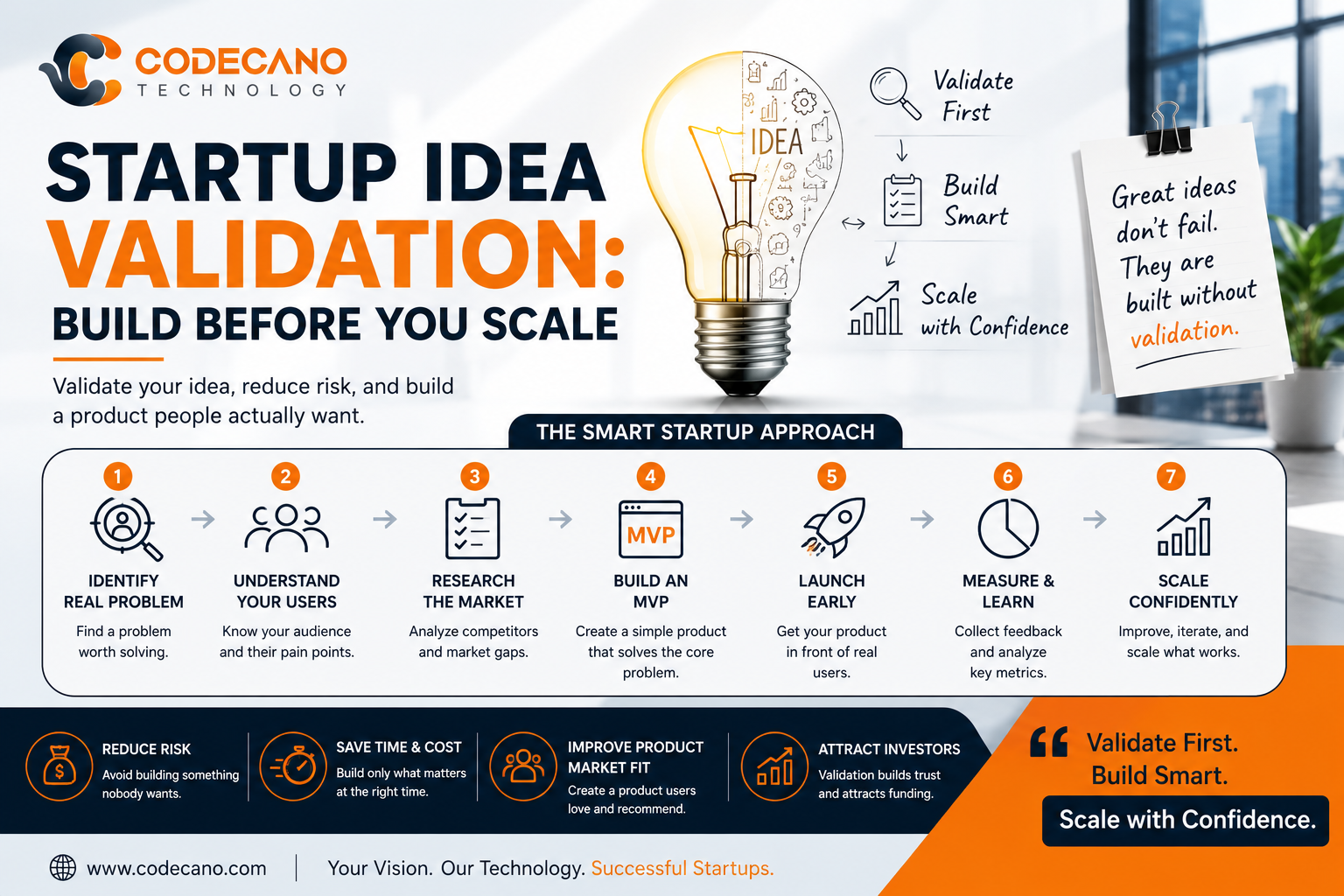
Great startup ideas don't fail because of poor technology—they fail because there's no market demand. Learn how to validate your startup idea before investing heavily in development, marketing, or hiring. Discover practical strategies to reduce risk, save money, and build products customers actually want.
Startup Idea Validation: Build Before You Scale
Every year, thousands of startups launch with exciting ideas, talented teams, and ambitious goals.
Yet, most of them fail.
Not because the technology was poor.
Not because they lacked funding.
They failed because they built something people didn't need.
According to multiple startup studies, lack of market demand is one of the leading reasons startups fail. That's why validating your idea before scaling is one of the smartest investments you can make.
In this guide, we'll show you how to validate your startup idea, minimize risk, and build a product people are willing to use—and pay for.
What Is Startup Idea Validation?
Startup idea validation is the process of testing whether your business idea solves a real problem for a real audience before investing significant time and money into development.
Instead of asking:
"Can we build this?"
Successful founders ask:
"Should we build this?"
The goal is to gather real-world evidence that customers want your solution before scaling.
Why Validation Matters
Building software is expensive.
Marketing is expensive.
Hiring employees is expensive.
But building the wrong product is even more expensive.
Validation helps you:
- Reduce financial risk
- Save development costs
- Understand customer needs
- Improve product-market fit
- Launch faster
- Increase investor confidence
The earlier you validate your assumptions, the less money you'll waste.
Step 1: Identify a Real Problem
Many founders fall in love with their idea.
Successful founders fall in love with solving customer problems.
Ask yourself:
- What pain point am I solving?
- Who experiences this problem?
- How often does it occur?
- How are people solving it today?
- Why isn't the current solution good enough?
If you can't clearly define the problem, it's too early to build a product.
Step 2: Define Your Ideal Customer
Your product isn't for everyone.
The more specific your target audience, the better your chances of success.
For example:
Instead of saying:
Small businesses
Define:
Restaurants with 10–50 employees struggling with online ordering.
Or:
Construction companies managing equipment rentals manually.
The more precise your audience, the easier it becomes to validate demand.
Step 3: Talk to Potential Customers
Don't rely on assumptions.
Talk to the people you're building for.
Ask questions like:
- What's your biggest challenge?
- How do you currently solve it?
- What's frustrating about the current solution?
- Would you pay for a better alternative?
- What features matter most?
Listen more than you speak.
Patterns will quickly emerge.
Step 4: Research Your Competitors
Competition isn't a bad sign.
It's proof that a market exists.
Analyze competitors by asking:
- What are they doing well?
- What do customers complain about?
- Which features are missing?
- How do they price their product?
- What opportunities exist?
Your goal isn't to copy competitors.
It's to build something better or more focused.
Step 5: Build an MVP, Not a Full Product
One of the biggest mistakes founders make is trying to launch with every feature they can imagine.
Instead, build an MVP (Minimum Viable Product).
Your MVP should solve one primary problem exceptionally well.
For example, instead of launching a complete marketplace with messaging, AI recommendations, loyalty programs, and analytics, start with:
- User registration
- Product or service listings
- Search functionality
- Booking or purchasing
- Payment integration
Everything else can come later.
Step 6: Launch Early
Perfection delays progress.
Release your MVP as soon as it's usable.
Real users provide better feedback than internal meetings ever will.
Track:
- Sign-ups
- Active users
- Customer retention
- Feature usage
- Conversion rates
- Customer feedback
These insights help shape your next product iteration.
Step 7: Measure Product-Market Fit
Validation doesn't end after launch.
Monitor key metrics such as:
- Customer acquisition cost (CAC)
- Customer lifetime value (LTV)
- Monthly recurring revenue (MRR)
- Retention rate
- Churn rate
- Net Promoter Score (NPS)
If users continue returning and recommending your product, you're moving toward product-market fit.
Common Validation Mistakes
Building Too Many Features
Every extra feature adds time, complexity, and cost.
Focus only on solving the primary problem.
Ignoring Negative Feedback
Constructive criticism is valuable.
If customers repeatedly highlight the same issue, address it instead of dismissing it.
Talking to Friends Instead of Customers
Friends often want to encourage you.
Potential customers provide honest feedback because they're evaluating whether your product solves their problem.
Waiting Too Long to Launch
Many founders spend a year building a product before showing it to anyone.
Launch sooner.
Learn faster.
Improve continuously.
Signs Your Startup Idea Is Worth Scaling
You may be ready to invest further when:
- Customers actively use your product.
- People are willing to pay.
- Users recommend it to others.
- Customer retention is improving.
- Feature requests align with your roadmap.
- Revenue is growing consistently.
Scaling before validation often amplifies existing problems.
Validation before scaling creates sustainable growth.
The Build → Measure → Learn Cycle
Successful startups don't build once.
They continuously improve.
The cycle looks like this:
- Build a simple MVP.
- Launch to real users.
- Measure user behavior.
- Collect feedback.
- Improve the product.
- Repeat.
Every iteration reduces uncertainty and increases the chances of long-term success.
How Codecano Technology Helps Startups
At Codecano Technology, we work with founders from idea to launch.
Our startup-focused development approach includes:
- Product discovery workshops
- MVP planning
- UI/UX design
- Web and mobile app development
- SaaS platform development
- API integrations
- Cloud deployment
- Ongoing maintenance and scaling
Rather than building unnecessary features, we help startups create lean, scalable products that reach the market faster and evolve based on real customer feedback.
Final Thoughts
A successful startup isn't built by writing more code—it's built by solving the right problem.
Before investing months of development or thousands of dollars, validate your assumptions with real customers.
Start small.
Launch early.
Learn quickly.
Scale only after you've proven that people genuinely want your solution.
The smartest founders don't build everything first.
They validate first—and scale with confidence.